


Quick answer
In the MRC’s 2025 first-party misuse evidence panel, 69% reported using an account or login identifier, up seven points from 62% in 2024. Shipping-address use rose six points, from 58% to 64%. These are merchant reporting shares, not dispute win rates.
MRC, Visa Acceptance Solutions and Verifi, 2025 Global eCommerce Payments & Fraud Report
Key findings and sources
Account or login identifiers rose seven points
In MRC’s first-party misuse evidence panel, account or login identifier use increased from 62% in the 2024 edition to 69% in the 2025 edition, a seven-point difference.
MRC, Visa Acceptance Solutions and Verifi, 2025 Global eCommerce Payments & Fraud Report
2024 n=410 and 2025 n=491 evidence-panel respondents. Subtract 62 from 69.
Shipping-address use rose six points
The MRC evidence panel reports that 64% of the 2025 respondents used delivery or shipping addresses, versus 58% in 2024.
MRC, Visa Acceptance Solutions and Verifi, 2025 Global eCommerce Payments & Fraud Report
MRC fraud-professional evidence panel. Calculate the six-percentage-point difference across samples.
IP and login identifiers led by 13 points over item details
Checkout Closer’s calculation puts the 2025 MRC evidence-use gap at 13 points between the jointly highest fields, IP address and account or login identifier, and item information.
MRC, Visa Acceptance Solutions and Verifi, 2025 Global eCommerce Payments & Fraud Report
2025 MRC evidence panel, n=491. Subtract item information’s 56% from either joint leader at 69%.
Device and item evidence had the same three-point change
In the MRC evidence panel, use of device identifiers moved from 54% to 57%, and use of item information moved from 53% to 56%. Both changes are three percentage points.
MRC, Visa Acceptance Solutions and Verifi, 2025 Global eCommerce Payments & Fraud Report
2024 and 2025 MRC evidence panel. Subtract each earlier share from the corresponding later share.
Compare the results
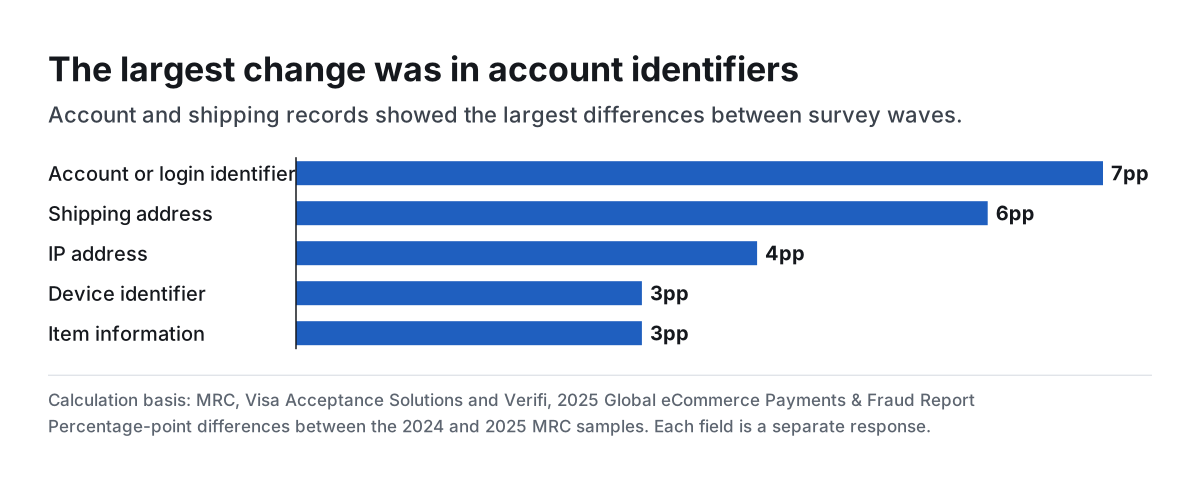
The largest change was in account identifiers
Account and shipping records showed the largest differences between survey waves.
The most-used field was a tie
In 2025, the MRC panel put account or login identifiers and IP addresses at 69% each. Shipping addresses followed at 64%, device identifiers at 57% and item information at 56%. That is a 13-point gap from the joint leaders to the least-used field shown. It is a description of reported practice, not a measure of how decisive any field was.
Account or login identifier use rose seven points compared with the prior sample. Shipping address use rose six. Different survey bases prevent assigning a change to any individual merchant. A payments team can still use the ranking to ask which records it can actually connect to the disputed order.
Work from the disputed order, not from a shopping list of data
Reconcile the order record, payment reference, fulfillment record and any shopper correspondence using your approved tools. Record which systems generated each item of evidence, what event it describes and whether the times line up. An identifier that cannot be traced to the transaction has limited explanatory value.
The source does not grant permission to collect extra personal data or imply that the same materials qualify in every network programme. Work within existing access and retention controls, and confirm evidence requirements and deadlines with the payment provider.
Make the buyer’s first route to resolution clear
Some disputes begin as a delivery question, a refund-status question or a charge the buyer cannot recognize. Preserve a clear way to find the order and route that issue appropriately before a team treats it as misuse. Track the original issue separately from whatever evidence is later assembled.
Measure whether your team can resolve order inquiries faster, retrieve eligible records when a dispute does occur and keep processing time low. These are different outcomes from survey adoption or a network decision.
Study data
| Measure | Value | Context |
|---|---|---|
| 2025 IP address | 69% | Published source value |
| 2024 IP address | 65% | Published source value |
| 2025 account login ID | 69% | Published source value |
| 2024 account login ID | 62% | Published source value |
| 2025 shipping address | 64% | Published source value |
| 2024 shipping address | 58% | Published source value |
| 2025 device ID | 57% | Published source value |
| 2024 device ID | 54% | Published source value |
| 2025 item information | 56% | Published source value |
| 2024 item information | 53% | Published source value |
| 2025 evidence-panel respondents | 491 respondents | Published source value |
| 2024 evidence-panel respondents | 410 respondents | Published source value |
What changes when you compare the figures
| Comparison | Result | Calculation |
|---|---|---|
| Account login ID change | 7 percentage points | = 69 - 62 |
| Shipping address change | 6 percentage points | = 64 - 58 |
| IP address change | 4 percentage points | = 69 - 65 |
| Device ID change | 3 percentage points | = 57 - 54 |
| Item information change | 3 percentage points | = 56 - 53 |
| 2025 top-to-bottom evidence use gap | 13 percentage points | = 69 - 56 |
Methodology and sources
We read the two waves of the data-point panel in MRC Figure 32. We subtract the 2024 share from the 2025 share for each field and rank the absolute point changes. The published bases are 491 and 410 respondents. Because the fields can be used together, the percentages are not a partition and do not add to 100. We do not infer whether a field was required, successful, or used in a particular dispute.
Download the source data (CSV)
Download the calculations (CSV)
Download the citation notes (CSV)
Related reading
Ecommerce payment tokenization statistics by token type and merchant size
Checkout payment statistics for wallets, cards and one-click checkout
Payment decline and retry statistics for online checkouts
Sources and definitions
MRC, Visa Acceptance Solutions and Verifi, 2025 Global eCommerce Payments & Fraud Report
The source data includes the population, period, denominator and limitations for every figure.